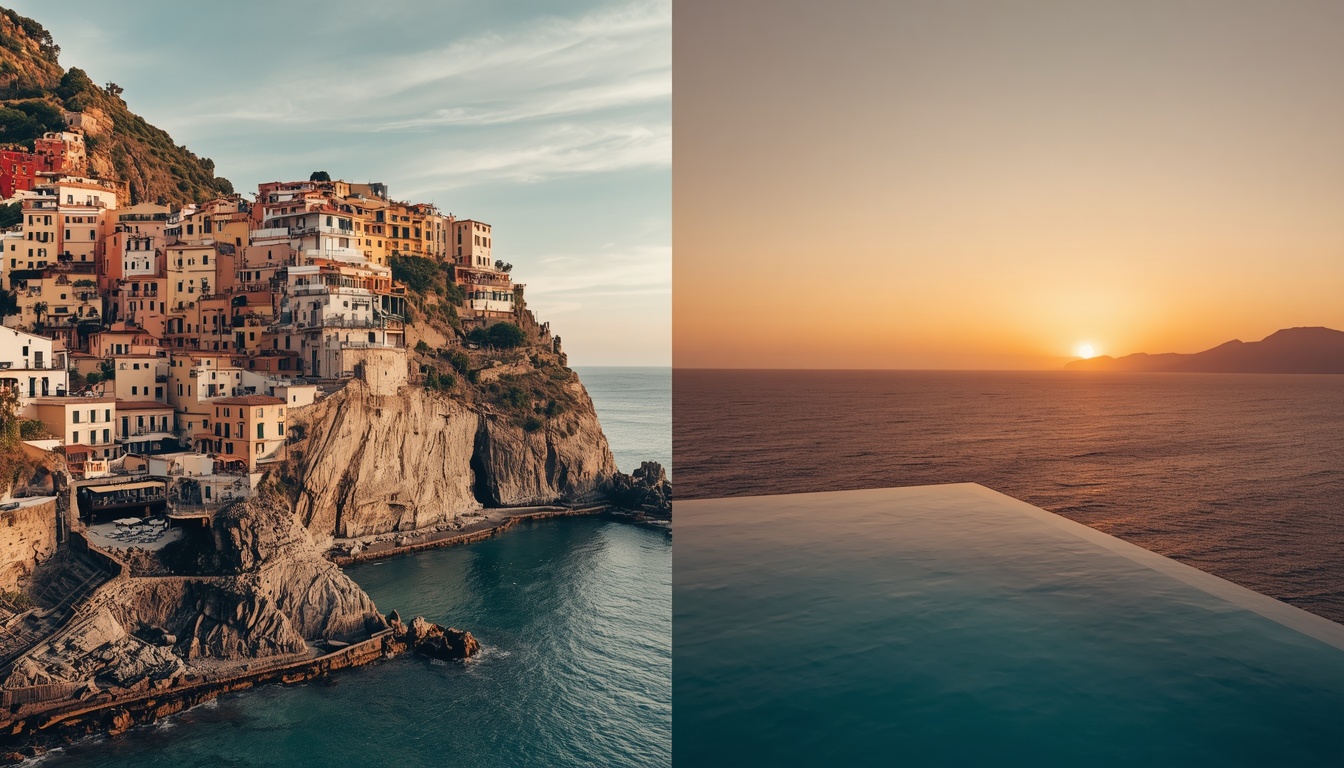
Italy and Spain compete for the same group: high-net-worth, flying from the US, wanting something that feels genuinely European and genuinely extraordinary. Both countries deliver. The question is which one delivers what your group actually needs.
This is the honest comparison.
The experience: what each country actually feels like
Spain moves faster. The beach clubs are more developed, the nightlife infrastructure is more sophisticated, and the transition from a villa morning to a beach club afternoon to a Michelin dinner to a night out is something Spain has refined into an art form. Ibiza, Marbella, and Barcelona are destinations that have been serving this exact market — international luxury groups — for decades. The infrastructure is there and it works.
Italy is slower, in the best possible sense. The Amalfi Coast doesn’t have beach clubs in the Spanish sense — it has boat days, cliff swims, lemon-grove lunches, and dinners on terraces above the sea. The pace is set by the landscape rather than the social scene. Sicily has a similar quality: ancient, dramatic, and deeply itself. For groups that want to feel immersed in a place rather than being entertained by it, Italy offers something Spain can’t.
The simplest summary: Spain is a more produced experience. Italy is a more discovered one.
The villas
Both countries have exceptional private villa stock. The differences are meaningful.
Spain’s villas — particularly in Ibiza and Mallorca — are more architecturally contemporary, more likely to have infinity pools designed for the view, and better equipped with the concierge infrastructure that luxury groups expect: private chefs, drivers, in-villa spa services. The booking systems are more developed, the vendor networks are more established, and the language barrier is lower for English-speaking guests.
Italy’s villas are more historic. A villa on the Amalfi Coast is likely to be a centuries-old property with thick stone walls, terraced gardens, and views that have been unchanged for generations. The aesthetic is incomparable. The logistics are more complex — the narrow roads of Positano and Ravello make transfers challenging, and not all properties have the service infrastructure that Spain’s villa market takes for granted.
For groups where the villa itself is the centrepiece of the trip, Italy’s properties have an architectural soul that Spain’s market rarely matches. For groups where the villa is the base from which everything else operates, Spain’s infrastructure is more reliable.
The food
This is where the comparison becomes genuinely difficult, because both countries operate at the highest level of European gastronomy.
Spain has more Michelin stars per capita than almost any country in the world. Barcelona alone has four three-starred restaurants. Marbella has four stars across its dining scene. San Sebastián — within reach for a longer trip — is one of the great food cities on earth. The beach club food culture is also more developed: Blue Marlin, La Cabane, Nobu Beach — these are venues where the menu would hold its own in a standalone restaurant.
Italy has a different kind of food authority. The Amalfi Coast’s cuisine is rooted in ingredients — the lemons, the anchovies, the local seafood — in a way that makes every meal feel connected to the place. A lunch of pasta alle vongole on a terrace above Positano, with a bottle of Falanghina and the sea below, is an experience that operates entirely outside the Michelin framework and is no less extraordinary for it. Sicily’s food is even more distinctive: Arabic-influenced, ancient, and unlike anything else in Europe.
The verdict: for formal fine dining and Michelin credentials, Spain. For food that feels inseparable from its landscape, Italy.
The logistics
Spain wins this category. Ibiza, Marbella, and Barcelona all have good international airport connections, well-developed private transfer infrastructure, and an established market for the kind of group travel that a luxury bachelorette requires. The language barrier is minimal — English is widely spoken in the luxury hospitality sector — and the vendor relationships that Bach & Joy has built across Spain mean that everything from a last-minute restaurant reservation to a helicopter transfer can be coordinated without friction.
Italy’s Amalfi Coast is famously logistically complex. The coastal road is narrow and dramatic. Towns like Positano and Ravello are accessible on foot or by boat more easily than by car. Transfers from Naples airport take longer than expected. The most beautiful villas are often the hardest to access. This complexity is part of the character of the place — but it requires a level of planning and local knowledge that is significantly higher than Spain demands.
Sicily is more straightforward logistically, with Palermo and Catania airports both well-served. But the island’s luxury infrastructure — private chefs, villa concierge services, high-end transfer operators — is less developed than Spain’s.
The timing
Spain’s window is May through October, with July and August as peak. The weather is predictable across all four main destinations.
Italy’s Amalfi Coast is best in May, June, September, and early October. July and August bring extreme crowds — the coastal road can become genuinely difficult to navigate, and the towns lose their charm under the weight of peak-season tourism. For a luxury group, the Amalfi Coast in July is a different proposition than the same destination in June.
Sicily is more flexible — April through October all work, with July and August hot but manageable given the island’s size.
The honest verdict
Choose Spain if:
- The group wants a highly produced, seamlessly managed luxury experience
- Beach clubs, Michelin dinners, and nightlife are part of the vision
- Logistics need to be simple and reliable
- The dates are peak summer and maximum availability matters
Choose Italy if:
- The group wants to feel like they’ve discovered something rather than arrived at a destination that already knows they’re coming
- A slower, more immersive experience is more appealing than a curated social scene
- The villa and the landscape are the experience, not the backdrop to it
- The dates are shoulder season — May, June, or September — when Italy is at its most beautiful and least crowded
Both are exceptional. The difference is in what the group wants to feel at the end of the trip.
Bach & Joy operates in Spain across Ibiza, Marbella, Barcelona, and Mallorca. If Spain is the right answer for your group, reach out here and we’ll start building the itinerary.